

Voting for Fools?
Sacred Slang Issue #3 - October 2024

Welcome to “Sacred Slang.” Each newsletter has six sections: Imagine, Interpret, Apply, Curate, Interrogate, and Horizon. I tried hard to make them all “I” words, but got stuck and gave up. Think of them like sections in a newspaper: read the ones that interest you, skip the ones that don’t. If you want to submit a question for next month’s “Interrogation” section - just reply to this email with your question.
Imagine.
Next month everything will change. Or it won’t. Maybe everything stays the same. I have no idea and neither do you. As the wise man said, “The lot is cast into the lap, but its every decision is from the LORD.” (Prov. 16:33)
Next month America fights for its very soul. Or it doesn’t. Maybe America has irretrievably lost its soul. I have no idea. As Jesus said, “Therefore do not be anxious about tomorrow, for tomorrow will be anxious for itself. Sufficient for the day is its own trouble.” (Matt. 6)
Next month is November, in a presidential election year. If you haven’t been paying attention the two primary options are bad, but they aren’t bad in the same way. But, they are both still bad. If you don’t think they are bad, I have reason to distrust you. And in truth, I don’t think you should trust yourself.
I have historically been reluctant to name names when it comes to politics, but it seems to me that this approach has not worked. When we act like these people are “they who should not be named,” we act a little bit like the phobic people around Harry Potter. Harry isn’t trying to be brave in speaking “Voldemort,” he just doesn’t have any reason to be afraid. He is the boy who lived. Death came. Death lost. “O death, where is your sting?”
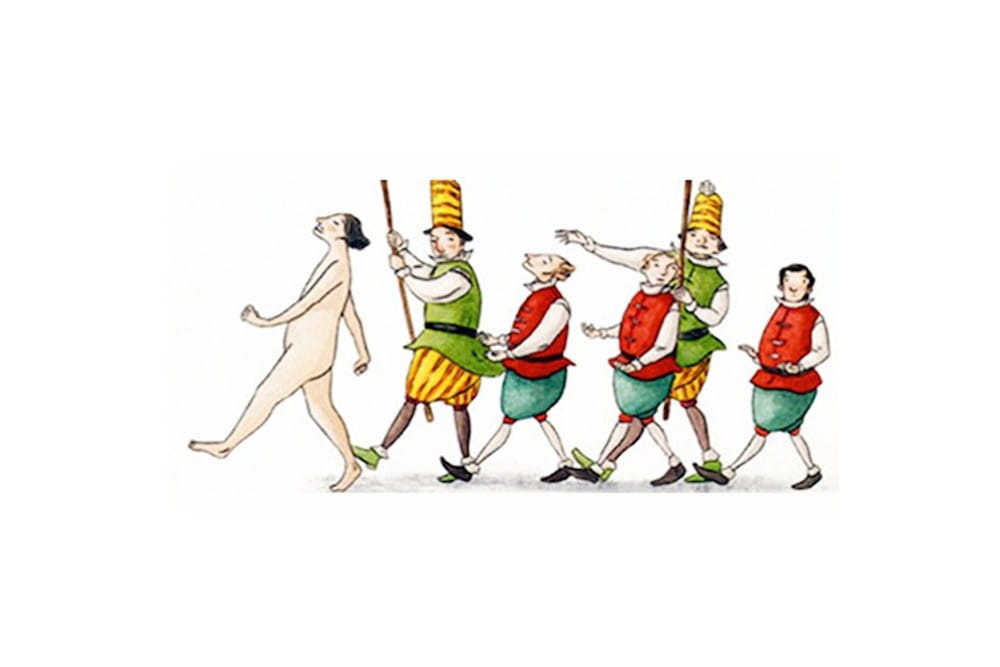
So, the living among us should probably be as bold as the fictional characters in our kids books. The emperor elects have no clothes. The only people who won’t admit this are the people who are also in their “birthday suit.” Delusion begets delusion begets delusion.
Donald Trump is unfit to be president. So is Kamala Harris. And yet it is a statistical certainty that one of them will become president. So, what do we do?
Well, some will vote. Some will vote for Donald Trump, though he is unfit to be president. Some will vote for Kamala Harris, though she is unfit to be president. They will rationalize this decision by saying it is for the “greater good” and that they have chosen the “lesser of two evils.” But only the insane will be proud of the vote they cast for either of these fools. And they are both fools. Unequivocally. Obviously. But they aren’t foolish in the same way.
Vice President Kamala Harris believes you should be able to kill babies. Full stop. That is an insane belief. It is immoral and wicked. Former President Donald Trump believes whatever it takes to win. And that is always going to be subject to change. So, one day, he might believe that a 5.5 week old baby can be killed without concern - and then a few days later - decide, “Whoopsy! I actually think 5.5 week old babies should not be killed without concern.” That is an insane way to lead. It is immoral and wicked.
One is foolish because she has ironclad beliefs in things that are immoral and insane. The other is foolish because it’s not clear he has any ironclad beliefs beyond, “I want to win.”
Some will not vote out of principle. They will abstain from voting because the candidates are so obviously immoral, wicked, and unqualified. They will refrain from their civic duty out of a profound sense that they have a moral duty - honor God and conscience above all.
Few will vote for a third party or write in candidate. A way of honoring the responsibility of citizenship and the voting process without having to give their vote to something they believe to be unconscionable.
Others will not vote out of laziness. These people are unfit for citizenship. Abstaining out of principle is a legitimate way forward. Not voting because you couldn’t be bothered is unacceptable. If you simply don’t participate because you are passive, make sure that you drive to your local graveyard to walk past and apologize at every headstone of a person who gave their life to defend our country. That’s your restitution.
All (Christians) must pray. I feel like when I say this, people hold back a bit of a scoff. Like when the doctor tells you to drink more water and get more sleep, you kind of feel like maybe he’s just being lazy, don’t you? When a pastor tells you, “We should pray.” It feels a bit like maybe he’s avoiding the real issue. And yet, the doctor is often right when he says to drink more water and get more sleep. And the pastor is always right when he says, “we should pray.” It happens to be the case that we are nowhere commanded in scripture to vote, but we are commanded in scripture to pray. And to pray specifically for the leaders of our land.
So, whether you vote or abstain from voting, you simply (as a Christian) cannot and must not abstain from praying.
To vote or not to vote - that is not the question.
Close your eyes and imagine a world where what you do in a ballot box every four years in November matters, but not nearly as much as what you do in your prayer closet. Now, open your eyes, that is the world you are in. Do not be afraid.
“The king’s heart is a stream of water in the hand of the LORD; he turns it wherever he will.” (Prov. 21:1)
Interpret.
(Below is a portion of my most recent article for Christianity Today - “Sports Betting Has Become Too Prevalent for Christians to Ignore.” You can access the full article here.)
The odds are good that you know someone who wagered on sports in the past year. With the rise in online sports betting, the industry now makes more than all the US major pro sports leagues combined. Americans are expected to bet $35 billion on NFL games alone this season.
Gambling is not a new temptation, but I believe that the advent of online sports gambling raises the stakes considerably on how seriously Christian leaders should address questions around the moral and theological nature of gambling.
Online sports betting companies sponsor broadcasts and sports media, so the push to play is everywhere, and it’s easy to join in. People can register and pay in just a few taps right on their phones. Plus, tying it to sports makes the gambling seem more innocent than poker and blackjack.
While sports gambling in any form is currently illegal in some very large states—including California, Texas, and Georgia—online sports betting is now legal and available in the majority of the country. For states like Texas, where I live and pastor, it seems probable that gambling will be made legal eventually.
As I speak with Christian leaders and church members about gambling, I often encounter hesitation. There is a reluctance among Christians to condone gambling but not enough opposition to condemn it outright. I think many Christians aren’t quite sure what to make of the morality of gambling.
In fairness, the Scriptures do not speak to gambling with the same degree of clarity and forcefulness with which they address other vices like adultery, drunkenness, and theft. It leaves us with the question, “Is gambling sinful?”
In Proverbs 13:11, we see an admonition against the hasty pursuit of wealth: “Wealth gained hastily will dwindle, but whoever gathers little by little will increase it” (ESV). We are repeatedly warned about the love of money in the New Testament: “Keep your lives free from the love of money and be content with what you have, because God has said, ‘Never will I leave you; never will I forsake you’” (Heb. 13:5)…
Is gambling sin? I don’t believe that Christians can see every instance of making a wager as sin. Is gambling wise? Rarely. Should Christians gamble? As a norm, I believe they should avoid it. Why? Well, not everything that is lawful is beneficial. There are things that don’t break the dictates of Scripture but are not wise.
Gambling treats what God has entrusted to our care with a spirit of carelessness. Its enterprise is exploitation, and its endgame is the hasty making and taking of wealth. Christians should be reluctant to participate in and support gambling of any kind, and
I believe Christian leaders should begin addressing online sports gambling with clarity and precision now.
(To read the rest of the piece, you can access the full article here.)
Apply.
I am a huge fight fan. People may object to the sport of it, but I train jiu jitsu 3-4 times a week and I appreciate watching all kinds of fighting: collegiate wrestling, boxing, kickboxing, and MMA above all. My passion and respect for fight sport will probably show up in deeper exploration in a future issue of Sacred Slang.
My love for the sport was not the only reason I was interested to watch “Noche UFC: UFC 306.” The other reason was because it was the first event of its kind to take place inside of “the Sphere.”
The Sphere is the newest mega venue in Las Vegas. And in a city known for innovating spectacle - the Sphere stands above even Vegas’ wild and crazy standards.
The Sphere is the largest high-resolution LED screen in the world. The exterior of the venue is a screen. Not part of the exterior. The whole exterior is called the “exo-Sphere” and it is is a 516 foot wide LED screen that produces 16Kx16K resolution video.
Inside of this screen there are over 17,000 seats. Some of them are equipped for “haptic” feedback. Meaning that they will rumble and move along with whatever is happening in the arena or on the screen.
Why is this fascinating?
In one way, the Sphere is merely another arena. But in another way, the Sphere is a picture of where we find ourselves: We aren’t just living with screens or around them, we now live in screens.
Architectural achievements always tell the story of their culture, age, and civilization. Whether made of clay, wood, brick, stone, or screen; all buildings are constructed from narratives. The Sphere is no different. In our world, in this age, the Sphere is possibly the most story accurate building you could imagine. It tells the story of a people who now dwell “en-screened.”
The German philosopher, Martin Heidegger, wrote extensively about what it means to be human. A core part of being human is “dwelling.” For Heidegger, “dwelling” wasn’t just where we lived, it’s how we experienced the world, dwelling is about where we exist and how that shapes us. The Sphere isn’t just a building, it is a symbol of the new way in which we “dwell,” the new way in which we live, a new mode of being.
One of the interesting things about UFC 306 was that the live performance happening within was rather disappointing. The fights weren’t that great. This isn’t merely one opinion, but basically the entire sports community agreed that the Sphere was worth watching - not because of any incredible performances from the athletes, but because of the visual spectacle of the building itself. Candidly, this is why I tuned in. There was a moment when I realized the sheer lunacy of what was happening: I had paid money to watch on my screen what was happening on a bigger screen in a different place. I didn’t have to go to Las Vegas to dwell in a screen - I transported myself there through another screen.
This is what dwelling does, the human heart will never be content to be near its greatest love, it will always long to inhabit it.
The spectacle of the Sphere pulled me in - and I was all excited to enter - the allure of finding myself inhabiting that which my heart has become all too willing to love.
Curate.
For years, I prepared a weekly brief of the most significant cultural “artifacts” for a strategic group of Christian leaders. In an age of endless information, curation is crucial. Each month I am going to point you towards what I believe to be articles, books, albums, and artifacts of consequence.1
The new Skye Peterson album, All the Difference, is very very good. Full of reflection on wonder, doubt, faith, ambition, and perseverance. I cannot recommend it more to you. Rarely will you find such a blend of honesty and hope.
I am reading my way through the works of Frederick Buechner and find myself wrapping up his novel Godric for the first time. Wow, don’t wait as long as I did to read this. Here is a taste of what you will find in its pages:
“What's prayer? It's shooting shafts into the dark. What mark they strike, if any, who's to say? It's reaching for a hand you cannot touch. The silence is so fathomless that prayers like plummets vanish into the sea. You beg. You whimper. You load God down with empty praise. You tell him sins that he already knows full well. You seek to change his changeless will. Yet Godric prays the way he breathes, for else his heart would wither in his breast. Prayer is the wind that fills his sail. Else drift with witless tides. And sometimes, by God's grace, a prayer is heard.”
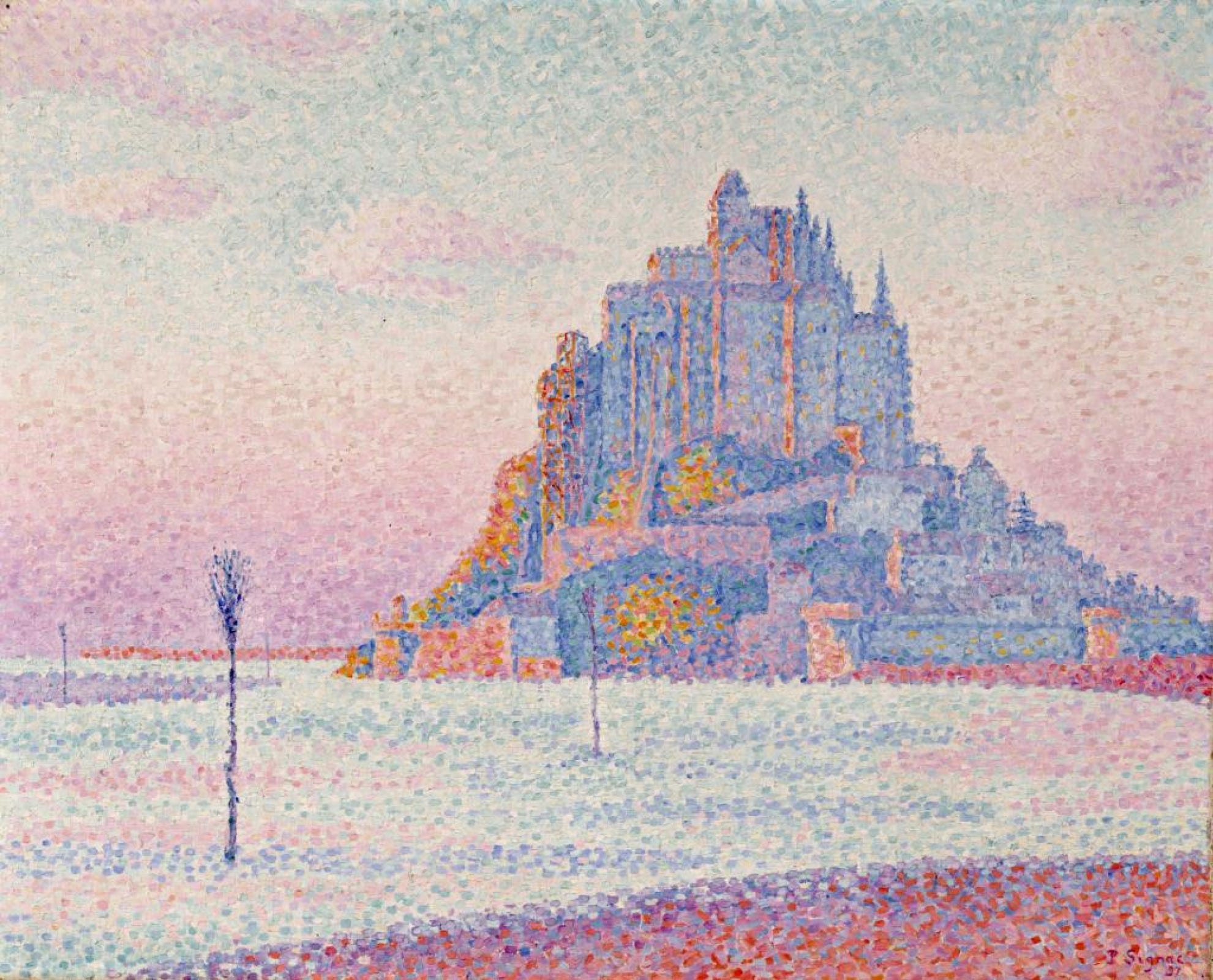
My daughter and I recently spent an afternoon walking through the Dallas Museum of Art’s exhibit on the impressionists. It was lovely. But the painting we couldn’t get out of our imagination was Paul Signac’s “Mont. St. Michel, setting sun.” A monastic community in France built the abbey on the rocky islet in the 8th century. Lydia, my daughter, said it reminder her of Cair Paravel from the Chronicles of Narnia. I think that’s a fantastic comparison.
What does this painting evoke in you?
Interrogate.
Each month I take a question from a reader. If you’d like to submit a question for a future issue of Sacred Slang, just reply to this email with your question.
Our question for this month comes from Austin: One thought I continue to have but I'm unsure how to put it into words is a connection between slavery and "Christians" who practice homosexuality. In both cases, a culturally hard-wired twisting of the Gospel leads to many accepting something as morally “okay” that Scripture is certainly against. But the question I can't stop wrestling with is how do we view the salvation of people who practice a clearly sinful viewpoint? Only the Lord knows the heart and no one can make a definitive judgment on this, but I don't think anyone would say "All slave-holders are condemned to hell.” So where does that leave us with those who practice a homosexual lifestyle?
Thanks for the question, Austin. This is a tricky question, but maybe not for the reason you might think.
The truth is, like you acknowledge, God will save all of His people and nothing is going to get in His way. Not even our sin. That being said, we should not live presumptuously in unrepentant sin nor encourage others to do so. Additionally, we should consider that living in unrepentant sin is identified as a sign that we truly have not experienced God’s grace and light. As John writes, “This is the message we have heard from him and proclaim to you, that God is light, and in him is no darkness at all. If we say we have fellowship with him while we walk in darkness, we lie and do not practice the truth.” (1 John 1)
So, that brings us to your question: Do we judge the slaveholding Christian different from the practicing homosexual who claims to be a Christian?
The answer is yes and no.
Why “yes?” Because the bible does not explicitly condemn slavery. This makes us uncomfortable, but it is true. The bible provides regulations for slavery in a society in which it already exists and it never endorses slavery or encourages a society to embrace it. But the bible does explicitly condemn homosexual practice. In this regard, we must judge the slaveholding Christian and the practicing homosexual differently. One practice is expressly prohibited and one is not.
But, why “no?” Because the bible provides a moral and theological architecture that should make both slavery and homosexual practice unthinkable and unconscionable. For someone to claim that they are comfortable, in light of the full revelation of God’s word, with enslaving individuals OR practicing sexual immorality should demonstrate to us that they are numb to the holy matters of God and should be considered as one lost in darkness.
Ultimately, God is the judge of who is and isn’t in Christ. But we, as God’s people, do have the responsibility to discern the fruit of those who claim the name of Christ. All those who claim the name of Christ but walk in unrepentant sin, both sins of omission and commission, should be exhorted to abandon their sin in repentance and turn towards the way of Christ.
(If you’d like to submit a question for a future issue of Sacred Slang, just reply to this email with your question.)
Horizon.
Jen Wilkin, JT English, and I recently announced that in April 2025 we are launching the Deep Discipleship Program. This is a year long theological discipleship program built for small groups and churches. If you want to be among the first to know about this - subscribe to the Training the Church newsletter here. (Sign up is at the bottom of the page.)
In the next issue of “Sacred Slang,” I will be providing early access to the introduction and chapter one of my new book Home with God. Pre-orders available now.
As part of the Deep Discipleship program, I wrote a book on spiritual formation entitled Formed for Fellowship. This book is more than just some thoughts on spiritual disciplines, it covers everything from the practice of love to how we actively engage in spiritual warfare. Pre-orders available now.
My speaking calendar is filling up for 2025. If you are looking for someone to speak or teach at your event, check out my topics and speaker form here.
Three notes:
Some of these will be behind a paywall (I’ll let you decide whether or not you want to burn a “free article” on them or finally do your duty to the art of letters and subscribe).
You should anticipate that I do not endorse any of them in their entirety. If you read, watch, or listen and find them in some way objectionable. Be an adult.
They will not all be “new.” I may point you to an article I read last week or I may recommend an album from 35 years ago. Deal with it.
“This is what dwelling does, the human heart will never be content to be near its greatest love, it will always long to inhabit it.”
Oof. You didn’t pull any punches this week. Thanks for saying the things we’d rather not think about.