People are play-doh.
Not Plato, play-doh.

Homemakers in the 1930s had a problem. They loved their beautiful wallpaper, but if you cleaned the dirt off the wall with water, the water would ruin it. So, how do you get filth off your lovely wallpaper?
Enter Noah McVicker. Noah sold soap; which was big business at the time. Noah saw an opportunity to solve what we will call the “filthy wallpaper dilemma.” So he invented a putty that you could press into wallpaper in order to remove the grime without corroding the paper. It was immediately a huge success.
But then paper wallpaper fell out of fashion and was replaced with vinyl wallpaper, which could be cleaned with conventional soap and water. Fewer and fewer people needed Noah’s putty any longer. His company, which was now run by his nephew Joe, began to crumble.
Enter Joe’s sister in law Kay Zufall: a nursery teacher who discovered that the kiddos in her class loved playing with the putty. She suggested that Joe re-brand the putty and sell it as a toy to kids. Turns out sister Kay was a genius.
I don’t need to tell you that “Play-Doh” is a massive success. It’s been well stocked on every toy aisle since 1956 and few brands have done a better job of staying relevant for each new generation.
Truth be told: If I ever met Kay Zufall, I’d give her a huge hug.
“Play-Doh” is such a low risk, high fun, easy to clean up toy to give a squirmy two year old that I could almost write poems about it. Any tired parent reading this knows the relief that comes with being able to sit for ten minutes of reprieve as your toddler smashes the purple putty into the green putty. Worst case, they eat a bucket of the non-toxic putty and have the worst stomach ache they’ve ever had. Best case scenario, you get a few minutes of (relative) peace.
My daughter thinks its hilarious that one of the most influential philosophers in history is named after playable putty. It doesn’t matter that Plato preceded the toy by two thousand(ish) years, she is stuck on the joke. I don’t blame her, because she might actually be onto something.
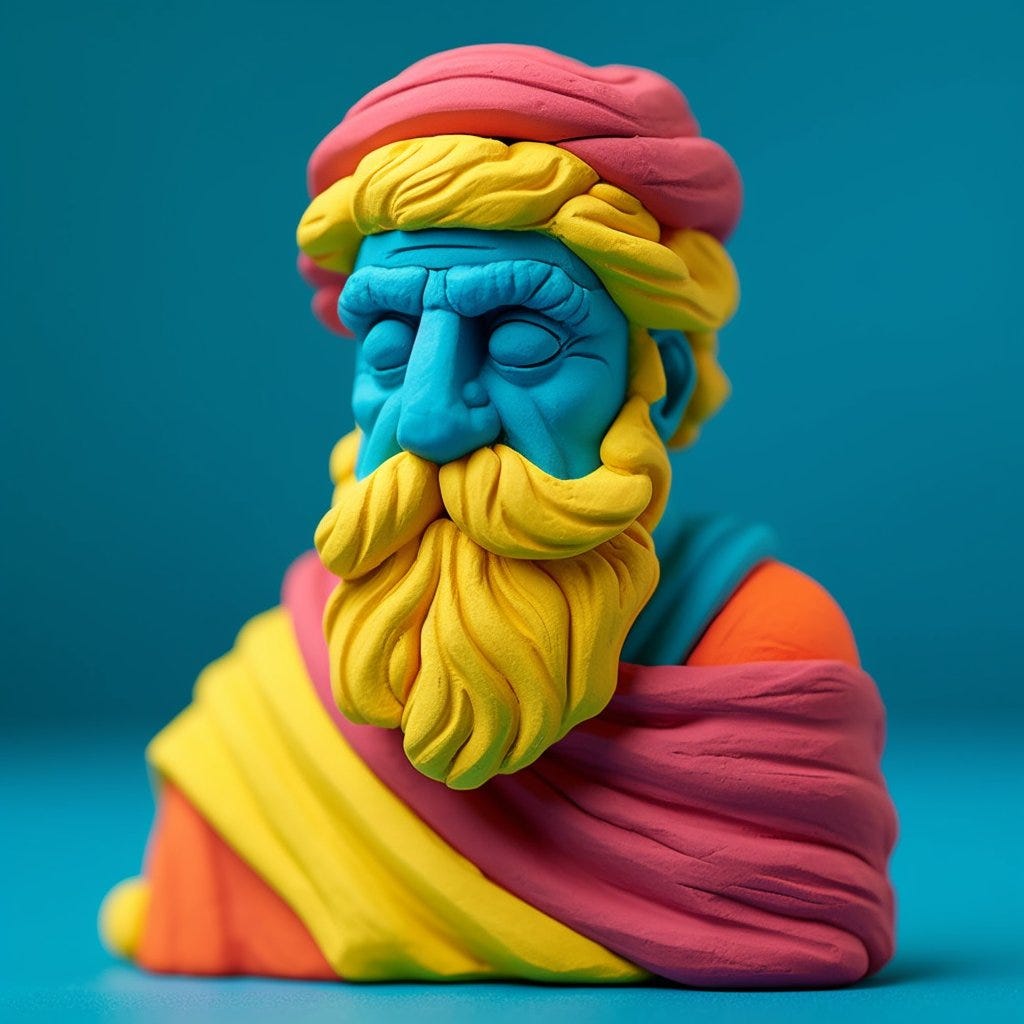
In truth, Plato was play-doh. Everyone is. You. Me. My daughter. Well, kinda.
We are malleable and impressionable. Designed to be shaped. We pick up whatever we are put on.
You might say that we, humans, are formed for fellowship.
This week marks the one year anniversary of a book I wrote on this very topic and this week only the kindle version is less than $5 (which seems crazy, but is not my problem).
The point of the book was to answer the question: What changes and shapes us? How do we become something different?

There is an intimate connection between what we “behold” and what we “become.”
For the Christian, the goal is to increasingly look more and more like Jesus. If you are a skeptic, you might think: “Yo, I don’t think it’s working out for you folks.” You wouldn’t be entirely wrong. But there is good news! The gospel begins with a transformation gift that then leads to a formation journey - the journey of the Christian life is to increasingly become who God has already said we are in Christ.
For my amateur philosophers out there: Being precedes becoming.
Essence comes before existence. Who we are in Christ is a gift received before how we live like Him is a journey undertaken.
God declares that we are His children when we place our faith in Christ Jesus. Then, He begins to use His Spirit and some rather ordinary practices (prayer, scripture, worship, evangelism, fasting, etc.) for us to increasingly look more and more like Jesus.
We (humans) are more malleable, bendable, and impressionable than we’d like to believe.
We are a bit like play-doh. We can soak up grime stained walls or we can be molded into the beautiful bust of a famous philosopher.
There is a Potter. And we are the clay.
If you are interested in exploring this idea a bit more, consider grabbing a copy of Formed for Fellowship: Becoming what You Behold wherever you like to get books. It’s available in audio, ebook, and print formats.
Don’t want to pay for a book or support the Bezos bookstore? Bless your neighbors and get access to the book for free by requesting it from local library.
The book is a part of a trilogy of books that are the core curriculum of the Deep Discipleship Program made possible by Lifeway. The book can be read on its own or in tandem with a one year theological immersion program that covers the basics of Christian Story, Christian Belief, and Christian formation. If you are interested in exploring that program click here.