

Getting a Cyclops Drunk. (Hospitality in "The Odyssey")
How is hospitality in Homer's epic different from the New Testament?

Howdy y’all - this essay is part of a four part series providing a Christian engagement with The Odyssey. I hope you enjoy it.
If you’d like to read the two previous entries, you can find them here:
All of my books (in every format) are on sale for Amazon’s Prime Day, Week, Month?
If you come visit our home we will usually offer you tea, coffee, and macarons. We keep a couple boxes of the frozen cookies from Trader Joes in our fridge so we are always ready to treat our guests. Unfortunately, I usually treat myself to them for a late night snack, much to the frustration of my hospitable wife who does our grocery shopping.
Admittedly, if we came home to find someone going through our cupboards, we probably would not offer them French sweets. On the other hand, we would also refrain from smashing them into rocks and eating their muddled remains.
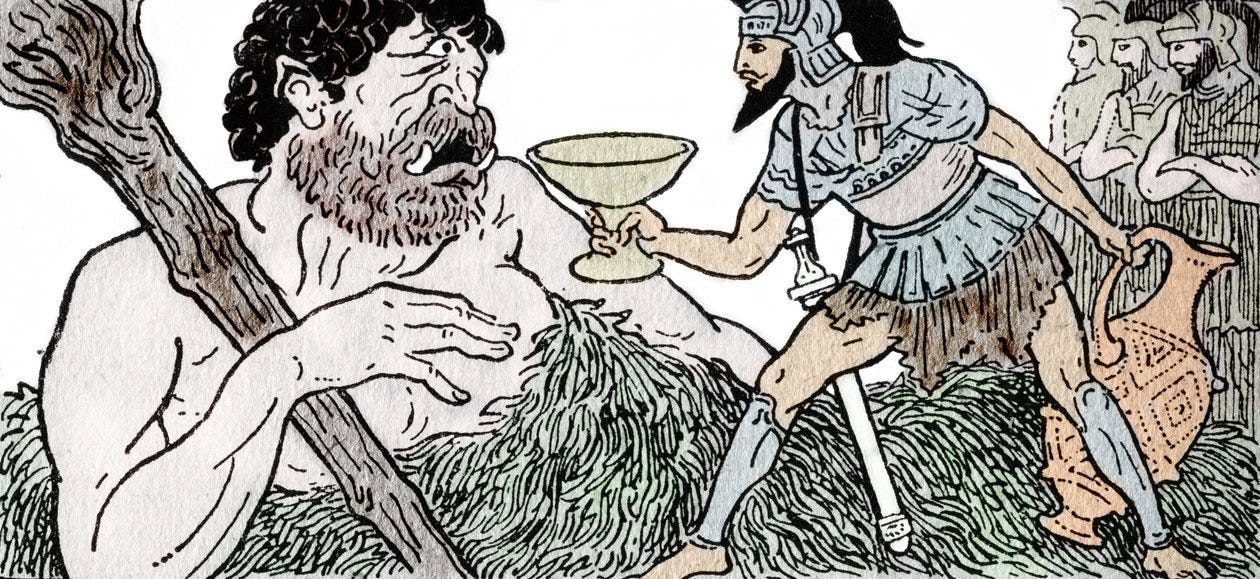
One of the most famous scenes in The Odyssey is when Odysseus and some of his crew mates go into the cave of a Cyclops in order to look for treasures. The Cyclops is a solitary shepherd who is minding his own business. He’s a monster, there is no doubt about it, but new readers of the epic are often surprised to discover that the Cyclops doesn’t go out of his way to harm Odysseus. He is provoked by their invasion of his home.
The whole scene unfolds as a wicked inversion of hospitality. Hospitality is a major theme in The Odyssey. In many ways, hospitality (or the lack thereof) drives the story forward from beginning to end. The Cyclops does not treat his “guests” hospitably, opting instead to treat himself to his guests. And what do you when you are trapped in a cave with a hungry and furious Cyclops?
You get him drunk of course! After he is absolutely sloshed, you take a burning spear and you shove it into his giant singular eye. That’s what The Odyssey is really about - it’s a manual about how to protect yourself from one eyed monsters.
The key word for readers of The Odyssey to grasp is “Xenia.” Xenia means “guest-friend.” This idea is central to understanding the dynamics of Homer’s epic. Xenia is a reciprocal hospitality between a host and stranger(s) and it is everywhere in Odysseus’ story:
The virtues of King Nestor and King Menelaus are showcased in how they show “Xenia” hospitality to Telemachus, because he is Odysseus’ son.
“Xenia” is abused by Circe, who uses magic to turn Odysseus’ crew into pigs.
“Xenia” is perverted by the Cyclops who doesn’t offer food to Odysseus and his crew, but treats them like food.
The only reason Odysseus is able to get back to Ithaca is because King Alcinous and Queen Arete extend “Xenia” hospitality by giving Odysseus gifts and a fully crewed swift ship to return him safely.
The wickedness of the suitors in Odysseus’ home is showcased in their unwillingness to show “Xenia” hospitality to strangers.
Throughout The Odyssey, we discover that the way you treat guests is a reflection of your character, your honor, and your standing with the gods. Zeus himself is referred to as the “god of guests” and the “protector of strangers.”
But The Odyssey isn’t the only ancient work in which hospitality figures prominently.
In Romans 12:13, the Apostle Paul writes, “Share with the saints in their needs; pursue hospitality (φιλοξενίαν).” The author of Hebrews in Hebrews 13:2 says, “Let brotherly love continue. Do not neglect to show hospitality (φιλοξενίας) to strangers, for thereby some have entertained angels unawares.” In 1 Peter 4:9, Peter calls the Christian community to “Show hospitality (φιλόξενοι) to one another without grumbling.”
Each of these verses includes a call to engage in “philo-xenia.” Philos means love and xenia means stranger. The call on the Christian community is to practice a love of strangers. The motivations are rooted in gratitude for what God has done, the potential that strangers might be more than meets the eye, and that hospitality is a witness to the world of the love of God.
This call to “love strangers” is slightly different than the “Xenia” we find in The Odyssey. In Homer’s epic, hospitality is motivated by fear, honor, glory, and gain. Routinely, the gifts of “Xenia” are given as a way of accruing or dispensing glory. Even when glory is not up for grabs, the hospitality granted is often compelled by fear that if it is withheld, then the gods might find you in need of a bit of divine correction.
But when we look at the New Testament, hospitality towards the stranger is less concerned with glory and has more to do with grace.
One of the central reasons that Jesus is chastised by the religious leaders of his day was because of his practice of hospitality, particularly at meals, towards those who were deemed “unclean” or “sinful” by the religious establishment. Glory is not the goal of Christ’s engagement with these people, grace is what grounds His hospitality.
Christine Pohl, in her book Making Room: Recovering Hospitality as a Christian Tradition, argues that even though we often think of hospitality as some kind of quaint and nice custom, “Christian hospitality has always had a subversive countercultural dimension.” One crucial piece of this countercultural practice of hospitality, a unique component of the Christian expression of “Xenia,” is that it is granted without any conditions or assurances of reciprocity.
In other words, Christian hospitality is unique in that it is granted unconditionally.
This would have been unintelligible to the Greeks of Homer’s day, but it makes complete sense for a community grounded in the reception of unconditional grace.
In a world of anonymity and dehumanization, among people who feel profoundly faceless and placeless, practicing “philo-xenia” (true hospitality) is a powerful witness. The Christian community seeks to articulate and share a “grace based” hospitality to friends, neighbors, and strangers in an effort to point to a glory that cannot be grasped.
Our welcome is a witness. I wonder what it says?
Kyle Worley is a pastor, author, and teacher. If you’d like to receive his weekly (and free!) newsletter right into your inbox each week, subscribe by clicking on the button below.
In our next essay, we will look to provide a Christian engagement with Homer’s view of “honor” in The Odyssey.